Biomechanical Tattoos Australia 2026: Complete Style Guide and Pricing
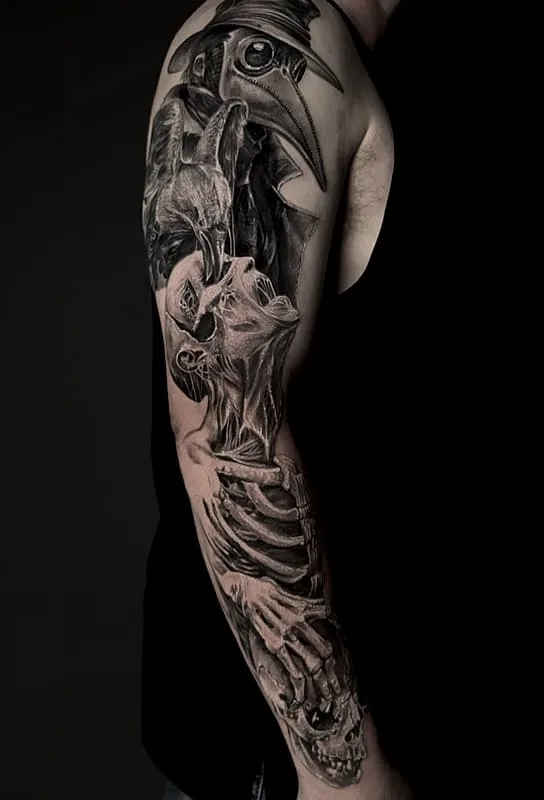
Picture this. You scroll past a tattoo photo and genuinely stop, because the arm you are looking at does not quite look human. A ribbon of torn skin peels back along the forearm, and underneath are hydraulic pistons, chrome rivets, and a copper cable that disappears into the elbow. The illusion is so clean it takes your eye a second to register that this is ink, not an engineering diagram.
That is biomechanical tattooing. It is one of the most technical styles in the game, one of the hardest to find a true specialist for in Australia, and one of the most polarising commitments a client can book. This 2026 guide walks through where the style came from, what makes it work on skin, what it costs in $900 to $3,500 brackets by size, who to look for in Sydney, Melbourne, Brisbane, Perth and Adelaide, and how to brief an artist without ending up with a tattoo that reads as busy noise instead of built machinery.
Key Takeaways
- Price band: $900 to $3,500 in Australia 2026 for a solid half-sleeve biomech piece, $4,000 to $9,000 for a full sleeve or thigh panel
- Session count: 3 to 6 sittings of 3 to 5 hours. Rushing a biomech piece is how the illusion collapses
- Skill premium: Expect $180 to $300 per hour. The style is realism with an extra technical layer and few artists book it as their main style
- Best placement: Upper arm, calf, chest and thigh. The piece needs muscle and movement to sell the mechanical illusion
- Palette: Black and grey is the classic. Colour biomech is possible but adds roughly 20 to 30% to session hours
- Design brief: Reference photos of actual machinery (watch movements, car engines, aircraft bays) beat generic "robot arm" prompts every time
- Red flag: An artist whose portfolio has one biomech piece buried among traditional roses probably treats the style as a one-off. Walk
What Makes a Tattoo Biomechanical
Biomechanical is not a motif, it is a visual grammar. The style treats the body as if it were a machine wearing a very thin layer of skin, and uses tattoo marks to suggest the hardware underneath. Three ideas carry the whole look.
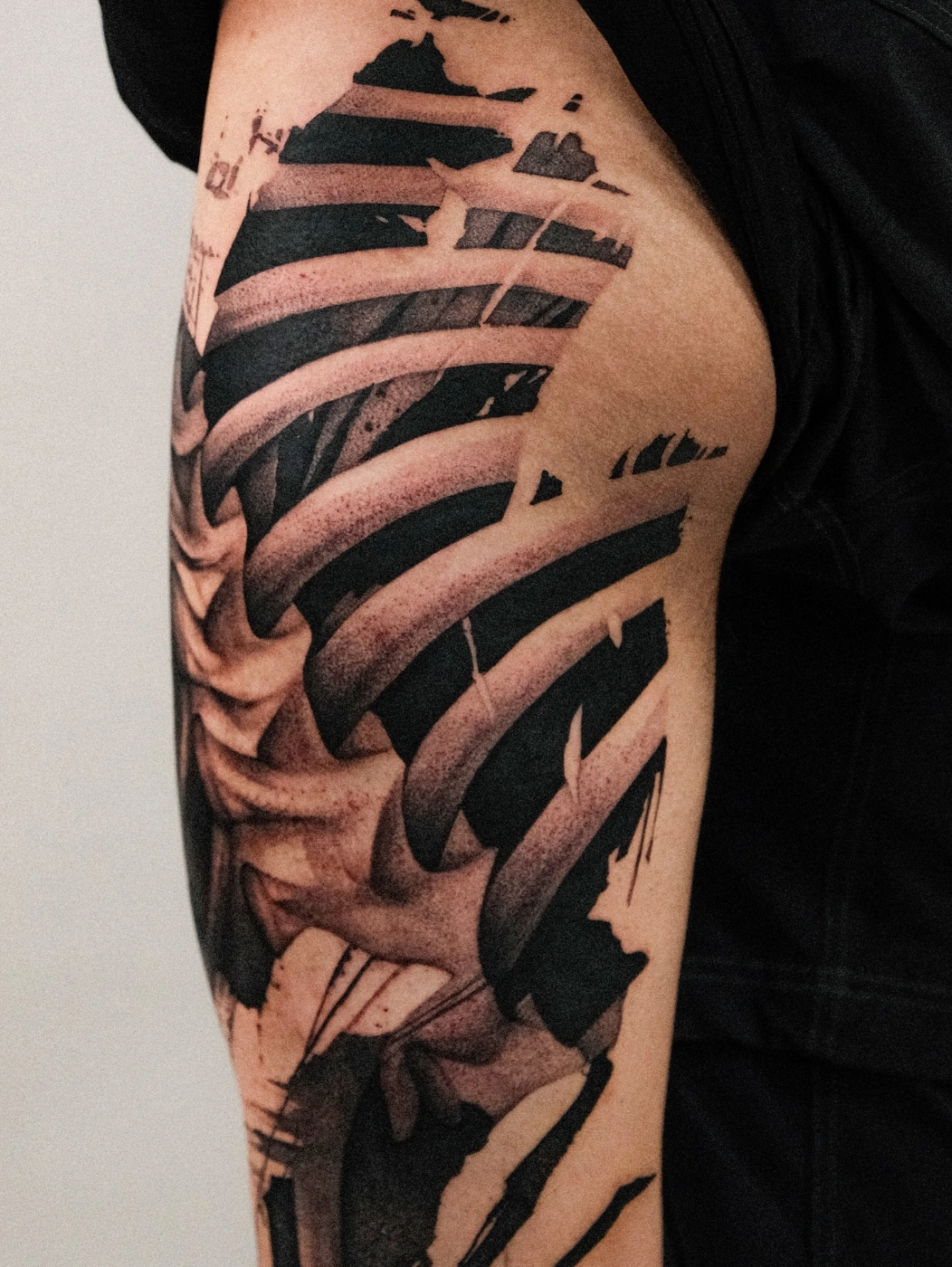
Torn or peeled skin. A biomech piece almost always has an "opening" somewhere, with ragged flesh edges that reveal the mechanical interior. The torn skin needs to flow with the muscle underneath, not fight it.
Mechanical interior. Gears, pistons, rods, hydraulic lines, rivets, printed circuit boards, carbon fibre weaves and cable looms. Modern biomech leans into real engineering references rather than generic "robot bits".
Three-dimensional illusion. This is the trick that separates good biomech from flat sci-fi doodles. The shadows have to behave as if the machinery sits below the skin plane, and highlights have to catch the viewer like a photograph.
In a nutshell: biomechanical tattoos are realism with a mechanical object as the subject. If the artist cannot already deliver a photo-grade portrait or a photo-grade skull, the biomech piece will not land either.
A Short History: From Giger to the Modern Studio
The style traces back to the Swiss painter and designer H. R. Giger, whose "Necronom" paintings became the visual DNA of Ridley Scott's 1979 film Alien. Giger's world fused anatomy with industrial detail, and tattoo artists started borrowing the language almost immediately. The 1980s and early 1990s brought the first wave of Giger tribute pieces, usually on American heavy metal fans.
The 2000s refined the style. Guy Aitchison in the United States, Roman Abrego in Mexico and a tight circle of European artists pushed biomech past Giger imitation into its own idiom. Convention floors filled with calf and shoulder pieces that read as personal engineering rather than movie poster fan art.
Across the last five years the style has shifted again. Steampunk biomech borrows Victorian brass and leather. Cyberpunk biomech leans into RGB-lit circuit boards and anime references. "Bio-organic" pieces drop the metal and keep the torn-skin illusion with alien tissue instead. In Australia today the pool of true biomech specialists is small but very good, concentrated in Melbourne, Sydney and Perth.

Core Design Elements and What Each One Buys You
The strongest biomech pieces are built from a shortlist of recurring parts, mixed and layered until the illusion holds. Here is a working inventory and what each element does for the composition.
| Element | Purpose | Common pitfall |
|---|---|---|
| Torn skin edges | Opens a "window" into the mechanical layer | Edges that run across muscle, not along it, kill the realism |
| Gears and cogs | Suggests motion and purpose, not decoration | Floating gears with no shaft look like stickers |
| Pistons and rods | Carry the eye along a limb | Pistons at wrong angles break the kinetic logic |
| Hydraulic lines, cables | Fills space, hints at systems off-page | Spaghetti cables with no origin or terminal look lazy |
| Rivets, bolts, panels | Grounds the illusion as hard surface, not fabric | Perfectly spaced rivets read as machine clip art |
| Highlight glints | Signals polished metal and three-dimensional depth | Too many highlights flatten the piece |
| Dust, grease, wear | Makes the hardware feel used, not CGI-clean | Overdone grime turns elegant engineering into mud |
If you are collecting references, pull them from real objects. A photograph of a 1970s Rolex movement, a Mustang V8, an F-111 avionics bay or a Dyson motor will give your artist more to work with than any amount of concept art.
Biomechanical Pricing in Australia 2026
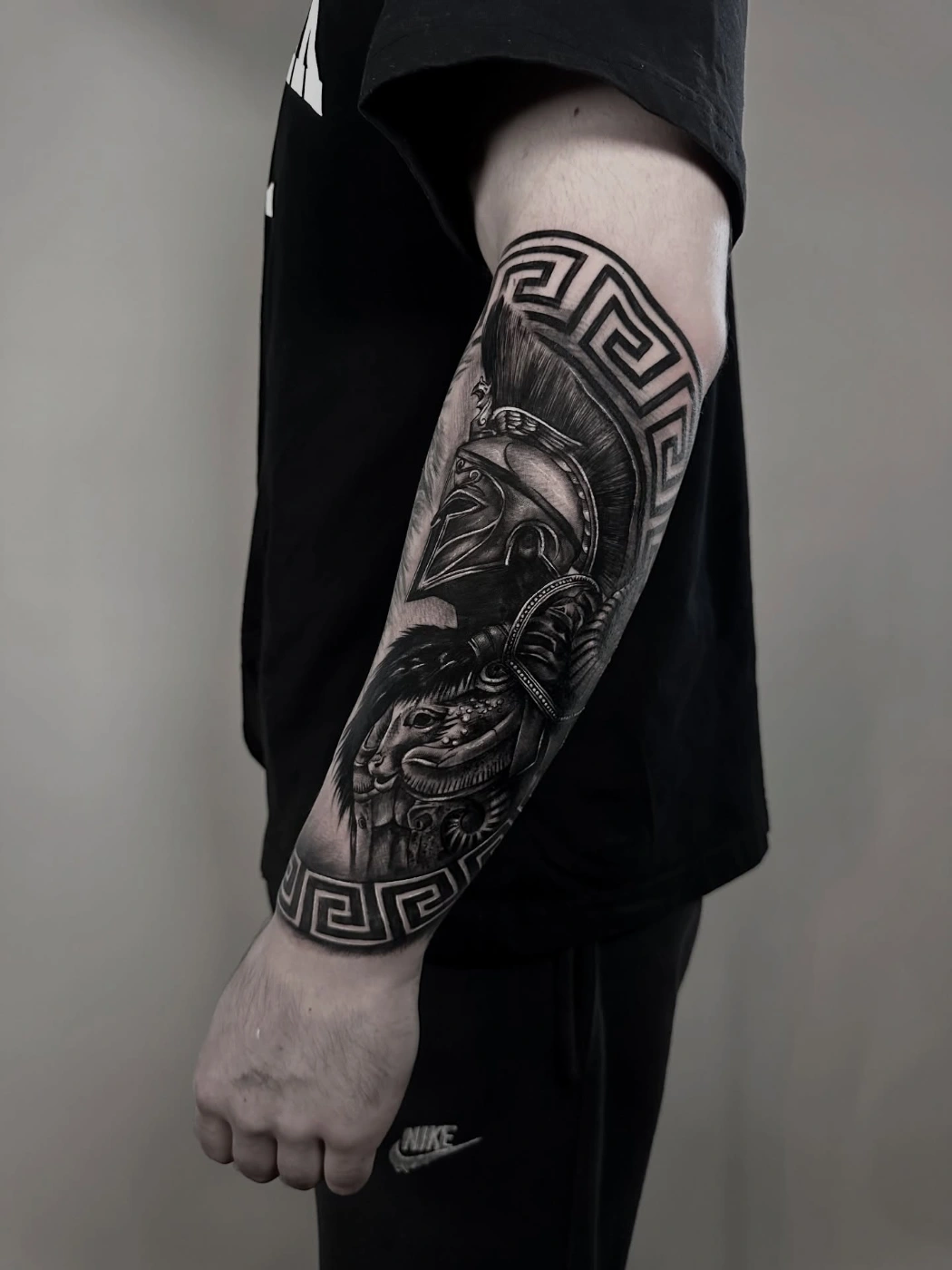
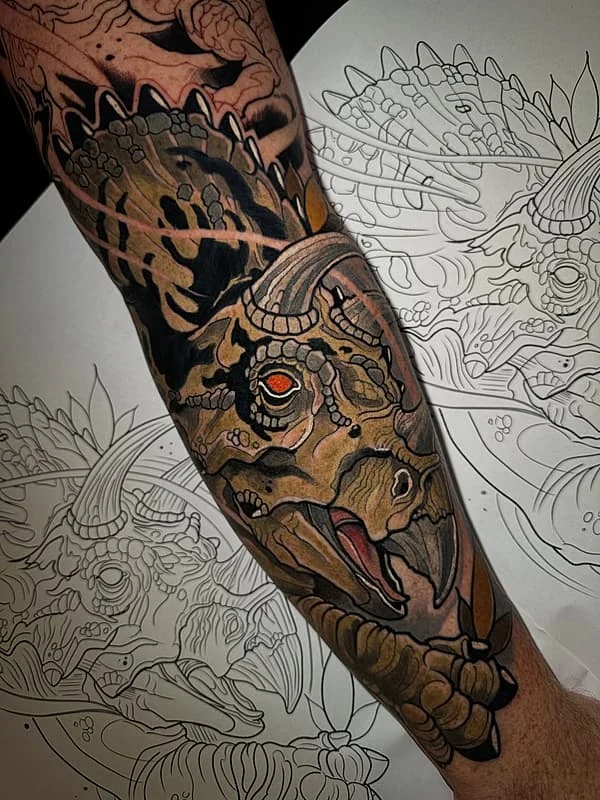
Photographs below are example portfolio pieces from real Australian artists on the platform. The cost breakdowns are illustrative averages based on typical Australian market rates and do not represent the actual fee charged for the specific tattoo shown.
Biomech sits at the premium end of tattoo pricing for one reason: hours. The style is dense, every square centimetre matters, and the illusion only works when the artist spends enough time blocking in base shading, laying highlights, and refining the metal texture. Expect to budget for a slow, careful project.
| Size | Price range (AUD) | Sessions | Total hours |
|---|---|---|---|
| Palm-sized panel (shoulder cap or calf feature) | $450-$900 | 1-2 | 4-7 hrs |
| Half-sleeve or quarter-leg | $900-$2,400 | 2-4 | 8-14 hrs |
| Full sleeve or full calf | $2,400-$5,500 | 4-7 | 18-30 hrs |
| Chest or back panel | $2,800-$6,500 | 4-8 | 20-35 hrs |
| Full back or full thigh | $4,500-$9,500 | 6-10 | 30-45 hrs |
Hourly rates for a true biomech specialist in 2026 sit between $180 and $300 per hour. Studio minimums ($100 to $150) and booking deposits ($250 to $500) are standard. For comparison with other large-format work, see our full sleeve tattoo cost guide.
City-level pricing
- Sydney: $200-$300/hr. Highest demand, longest waitlists for name-level artists
- Melbourne: $180-$280/hr. Deepest talent pool for the style
- Brisbane: $160-$240/hr. Smaller biomech scene, strong realism base
- Perth: $170-$260/hr. A few specialists do most of the big pieces here
- Adelaide: $150-$230/hr. Expect to travel or book a guest spot
Heads up: most quotes for biomech are hourly, not fixed price. The artist cannot tell you to the dollar until the stencil is on your skin and the first session reveals how your body reads the design. Budget for roughly 15% over the midpoint estimate.
Styles Within the Style
"Biomechanical" is a family, not a single look. Narrowing the sub-style before you book saves hours of consultation and prevents the dreaded "we built the wrong thing" moment on the second session.

Classic Giger-era biomech
Dark, dense, HR Giger adjacent. Lots of alien skeletal elements, teeth, bone-metal fusion. Reads moody and heavy. Works best on back, chest, thigh.
Steampunk biomech
Victorian industrial. Brass gears, exposed cogs, leather straps, rivets with heavy patina. Often tinted with warm browns and copper tones. Pairs well with pocket-watch and compass motifs.
Cyberpunk biomech
Modern tech aesthetic. Circuit traces, RGB-coloured LEDs, carbon-fibre weave, matte black panels. Can run full colour or clean black and grey with teal and magenta highlights.
Bio-organic
Keeps the torn-flesh illusion but swaps machinery for alien tissue, exposed sinew, insect carapace. More sculptural than mechanical. Great cover-up option for existing dark work.
Minimal biomech
A small panel of exposed mechanics on an otherwise bare limb. Great entry point if a full sleeve feels like too much commitment. Reads like a well-placed watch window on the forearm.
Best Body Placements and Pain Map
Biomech lives or dies on how the "machinery" interacts with the muscle it sits over. Flat canvases such as the back or outer thigh give the artist room to build. Curved, high-movement spots such as the elbow and wrist are harder to pull off and more painful.
| Placement | Pain (out of 10) | Suitability |
|---|---|---|
| Upper arm / bicep | 4 | Classic. Muscle sells the piston illusion |
| Forearm (outer) | 5 | Good. Highly visible, flat canvas |
| Calf | 5 | Excellent. Space, curvature, low wear and tear |
| Chest / pec | 6 | Dramatic. Needs a willing artist for the detail |
| Back (upper) | 5 | Best large-format canvas; low movement |
| Full thigh | 5-6 | Enormous canvas. Few spots rival it for scale |
| Inner forearm / elbow ditch | 8 | Painful and prone to blowout; skip the ditch |
| Ribs or sternum | 9 | Brutal. Reserve for experienced sitters |
Browse ideas by zone on our arm, calf, chest and back galleries before you commit to a placement.
Finding the Right Artist in Australia
Three questions filter a biomech candidate quickly.
Does the portfolio show at least ten biomech or heavy realism pieces, healed photographs included? Fresh ink always looks sharper. Healed photographs reveal whether the piece holds together after six months in Australian sun.
Do the mechanical elements interact with each other? Floating gears connected to nothing are a tell. Great biomech reads as if the hardware was there before the skin.
Can the artist show a consultation sketch rather than copying your reference? If every piece in the folio uses the same three stock elements, you are looking at a copyist, not a stylist.
Start your search by browsing studios in Sydney, Melbourne, Brisbane, Perth and Adelaide. Filter by realism and blackwork, then dig into Instagram for live sessions and healed-piece posts.
Healing, Longevity and Touch-Ups
Biomech is dense black and grey work. It heals well when treated like any other heavy realism piece, with two Australian-specific caveats.
Sun. The highlights that sell the metal illusion are the first thing to fade under UV. Daily SPF50+ on healed biomech ink is not negotiable in Perth, Brisbane or northern NSW. See our sun exposure guide for how to layer sunscreen without damaging fresh work.
Humidity and sweat. Dense black packing can scab heavily in Melbourne winter and Sydney summer alike. Follow a lean aftercare routine: unscented wash twice a day, light moisturiser three or four times a day, no soaking. The first 24 hours aftercare guide covers the opening window in detail.
Touch-ups at the twelve-month mark are standard for biomech. Most artists include one free touch-up inside six months and charge $150 to $400 at the one-year mark for highlight refreshes.
Longevity tip: biomech ages better than fine-line or watercolour because the illusion depends on contrast rather than crisp lines. Even softened edges still read as metal under skin, which is why fifteen-year-old biomech still looks right in modern feeds.
Estimate Your Piece in 30 Seconds
Plug design size, style complexity and city into our tattoo cost calculator for a quick AUD estimate based on live Australian studio data, with no email required.
Frequently Asked Questions
Is biomechanical the same as biomorphic or bio-organic?
No. Biomechanical mixes flesh with machinery. Biomorphic and bio-organic keep the torn-skin illusion but replace metal with organic tissue, alien matter or carapace. The techniques overlap, so a specialist usually offers both.
Can I combine biomech with another style on the same sleeve?
Yes, but ask your artist to design it as one composition from day one. Blending biomech into Japanese or neo-traditional mid-sleeve almost never works as a retrofit; the colour language, line weight and contrast levels fight each other.
How long will a biomech sleeve take start to finish?
Four to seven months on an average Australian booking schedule, assuming monthly sessions. Expect roughly 20 to 30 hours of needle time across the project.
Does it hurt more than other tattoo styles?
The style itself does not hurt more. The density does. Biomech is packed with heavy black and shading, so sessions tend to be long, and that drives perceived pain. Short-and-often is kinder than a single marathon.
Can biomech be used as a cover-up?
Yes. The dark palette and dense shading make biomech one of the strongest cover-up styles in the business. Expect the cover design to be at least twice the surface area of the piece underneath.
How do I know an artist will not just copy a Giger painting?
Ask for a consultation sketch before paying the full deposit. A specialist will send through a rough composition that uses your reference material rather than lifting an entire Giger panel. If the response is a traced copy, keep looking.
Bottom Line
Biomechanical tattoos in Australia 2026 cost $900 to $3,500 for a half-sleeve or feature panel, and up to $9,500 for a full back or thigh build. The style rewards patience, strong references and an artist who already works in heavy realism. Pick a specialist, brief with real engineering photographs, and treat the project as a four-to-seven month investment rather than a weekend booking.
Browse heavy realism and dark-art pieces across realism, blackwork and biomechanical galleries for design direction, then jump into studios in Sydney, Melbourne or Brisbane.
Explore More
Find Tattoo Shops
Browse by Style
Stay Updated with the Latest Insights!
Get the latest news and updates delivered to your inbox.
Related Articles
Tattoo Price Guide
Tattoo price guide for Australia 2026. Hourly rates, by-style and by-size pricing, city comparison, hidden costs, and how to budget.
Read More
Half Sleeve Tattoo Cost Australia 2026: Complete Pricing Guide
Half sleeve tattoo cost in Australia 2026: $800-$2,500 across 2-5 sessions. Style, city, and artist tier breakdowns plus payment plans.
Read More
Full Sleeve Tattoo Cost Australia 2026: Complete Investment Guide
Full sleeve tattoo cost in Australia 2026: $1,500-$6,000 over 4-8 sessions. Style, city, and artist tier breakdowns plus payment plans.
Read More